AI · 2026-11-10
NVIDIA or AMD? Two Paths for Korea’s Semiconductor Industry: Rebellions and Furiosa’s Choices
Korea’s AI semiconductor industry is exploring two different routes: joining NVIDIA’s ecosystem to build real-world references, or creating an open alliance centered on AMD. Here’s a look at why the collaboration between Rebellions and NVIDIA, and the partnership between FuriosaAI and MangoBoost, is drawing attention.
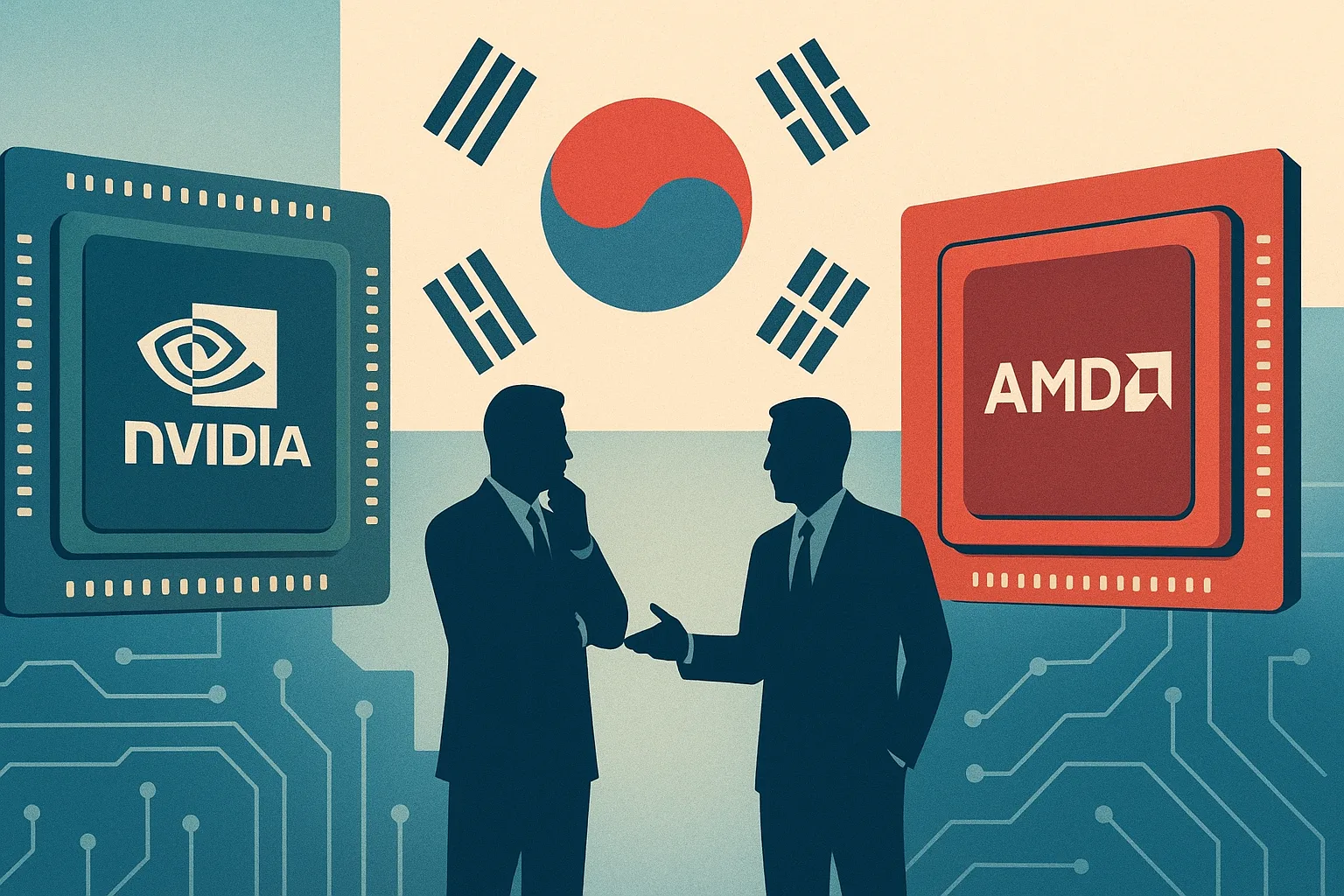
Korean AI semiconductor companies are choosing different strategies as they try to survive in the global market. One path is to join NVIDIA’s existing infrastructure and standards to quickly build customer references; another is to create an open ecosystem centered on AMD, connecting multiple types of chips. The recently announced partnerships show that K-semiconductor competition has not settled into just one direction.
Rebellions Rides on NVIDIA’s Infrastructure
According to a ZDNet Korea report, Rebellions announced a business agreement to join NVIDIA’s NVLink Fusion framework at NVIDIA AI Day in Seoul. The plan is to link Rebellions’ next-generation neural processing unit (NPU), “Rebell 200,” with NVIDIA’s MGX rack architecture. An NPU is a semiconductor designed for specific tasks such as AI inference, and it can handle data center computing alongside GPUs.
Rather than building an entire ecosystem from scratch, using NVIDIA’s widely adopted connectivity technology and design could reduce the burden of development and infrastructure setup, while also shortening the time it takes to bring products to market. That said, as dependence on a major platform increases, it becomes even more important to turn that into real customer wins and stronger competitiveness.
SK Telecom’s AI data center initiative is also aligned with this strategy. According to reports, NVIDIA GPUs and Rebellions NPUs would be used together inside the data center, while customers would access AI computing services through APIs without directly handling the hardware. The goal is said to be creating a real operational example for the government-led K-AI data center project.
An Open Alliance Centered on AMD Also Gains Momentum
On the other hand, there is a growing push toward heterogeneous computing that is not tied to a single big-tech company. FuriosaAI and MangoBoost signed a partnership agreement at an AMD event. The two sides were introduced as pursuing an AI computing package that connects different kinds of semiconductors based on AMD’s open ROCm ecosystem. Heterogeneous computing refers to using more than one type of chip depending on the task, instead of relying on only one kind.
These two choices are not simply a matter of picking NVIDIA or AMD. They are better understood as strategic decisions about which ecosystem each company will use to validate its products and secure customers. The NVIDIA platform offers the advantage of connecting with already established technology and infrastructure, while an open alliance leaves room to reduce dependence on a single provider and experiment with combinations of different chips. In the end, actual results will need to be proven not by the agreements themselves, but by product performance, stability, data center deployment, and customer demand.
For Korea’s fabless chipmakers to become globally competitive, they need more than just technology development. They also need the infrastructure and operational experience required to connect their chips to real services. In that sense, which side gains the upper hand will depend on the references built over time, the ecosystem participants involved, and customer choices. This collaboration race is expected to become an important proving ground for how K-semiconductors expand their presence in the global market.
※ Source: ZDNet Korea report
Source: "엔비디아냐 AMD냐"...기로에 선 K-반도체
Related search terms
#Korean AI semiconductor companies#Rebellions NVIDIA NVLink Fusion#FuriosaAI AMD partnership#K-semiconductor strategy#AI data center chips#heterogeneous computing ecosystem#fabless semiconductor competition