ECONOMY · 2026-11-02
President Lee Jae-myung Says Korea’s Economy Is in a “V-Shaped Recovery”… Urges “Growth for Everyone” Beyond K-Shaped Growth
In his budget speech for the 2027 fiscal year, President Lee Jae-myung said South Korea’s economy is showing a clear V-shaped recovery. At the same time, he laid out a vision of achieving “growth for everyone” through support for jobs, finance, and housing, moving beyond the so-called K-shaped growth that concentrates gains in certain regions and social groups.
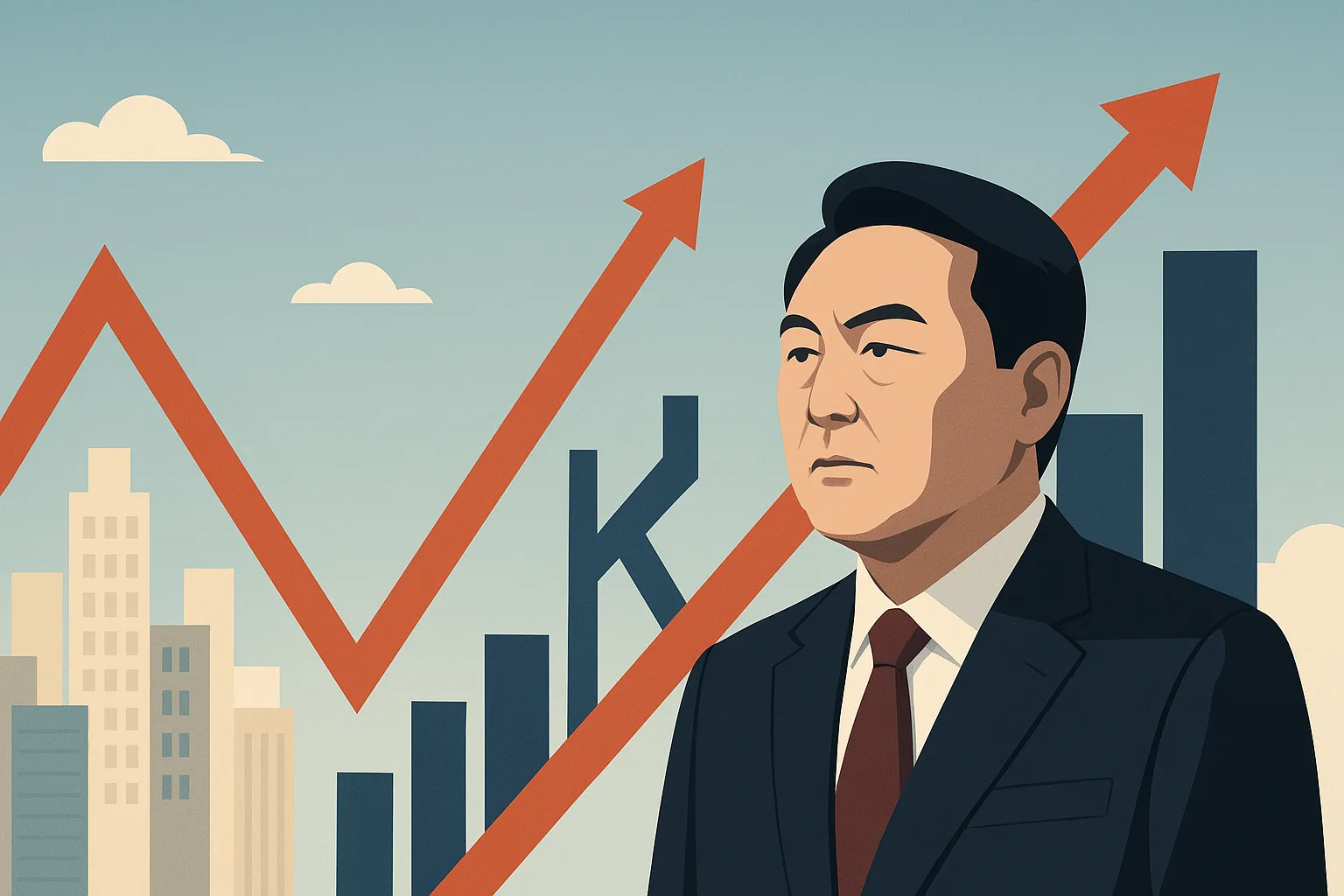
President Lee Jae-myung highlighted signs of recovery in the South Korean economy, while also saying the government must address the problem of growth benefits concentrating among only a few. In his budget speech for the 2027 fiscal year, as reported by Kyunghyang Shinmun, he described the economic situation as a “clear V-shaped recovery,” but said the new challenge is to overcome “K-shaped growth,” which deepens inequality and polarization.
A V-shaped recovery refers to an economy that falls sharply and then rebounds quickly. K-shaped growth, by contrast, describes a situation in which some industries or social groups recover and grow while others remain weak, widening the gap between them. President Lee raised the issue by suggesting that even if macro indicators such as growth rates improve, the meaning of growth should be reconsidered if ordinary people’s livelihoods do not get better.
In the speech, President Lee said the government had strengthened its fiscal role through two supplementary budgets and an expansionary main budget, helping protect the economy and people’s livelihoods from the shock of war in the Middle East. He also said first-half growth reached 3.8% this year and that annual exports were within reach of $1 trillion, thanks to the strong performance of key industries such as semiconductors. He said surpassing $40,000 in per-capita gross national income and entering the so-called “5040 club” were now within sight. These were all part of the president’s economic assessment and outlook in the speech.
As a policy direction, he emphasized “growth for everyone” so that all regions and citizens can share in opportunities and results, instead of “growth for the few,” where achievements are concentrated in certain regions and social groups. To put this into action, he mentioned a “three major livelihood projects” package combining large-scale jobs for people’s livelihoods, finance for ordinary households, and housing stability measures, and he also said he planned to pursue the “three major mega projects” and “seven SEEDs.” However, he did not explain every detail of these initiatives in the speech.
President Lee also said that the public funds injected during the foreign exchange crisis would be fully repaid by next year, bringing the total repayment to 97.2 trillion won and completing the recovery from the IMF crisis. Alongside indicators showing economic recovery, he also touched on the slow rebound in regional economies, the barriers young people face in landing their first jobs, and the difficulties of small business owners. In the upcoming budget debate, key points are expected to include not only growth rates and export performance, but also whether jobs, regions, and households can actually feel the recovery, and how the proposed livelihood policies will translate into real support.
Related search terms
#President Lee Jae-myung budget speech#Korea V-shaped economic recovery#K-shaped growth South Korea#growth for everyone policy#2027 South Korea budget#livelihood jobs finance housing support#South Korea economic outlook#IMF crisis public fund repayment