AI · 2026-10-31
Intel Stock Plunges 30%, Worst Since 1982 Amid Slower PC Demand and AI Investment Burden
Intel’s share price, which had more than doubled this year, tumbled nearly 30% in a single day. A weaker-than-expected sales outlook and concerns about deteriorating free cash flow triggered selling across the broader semiconductor sector as well.
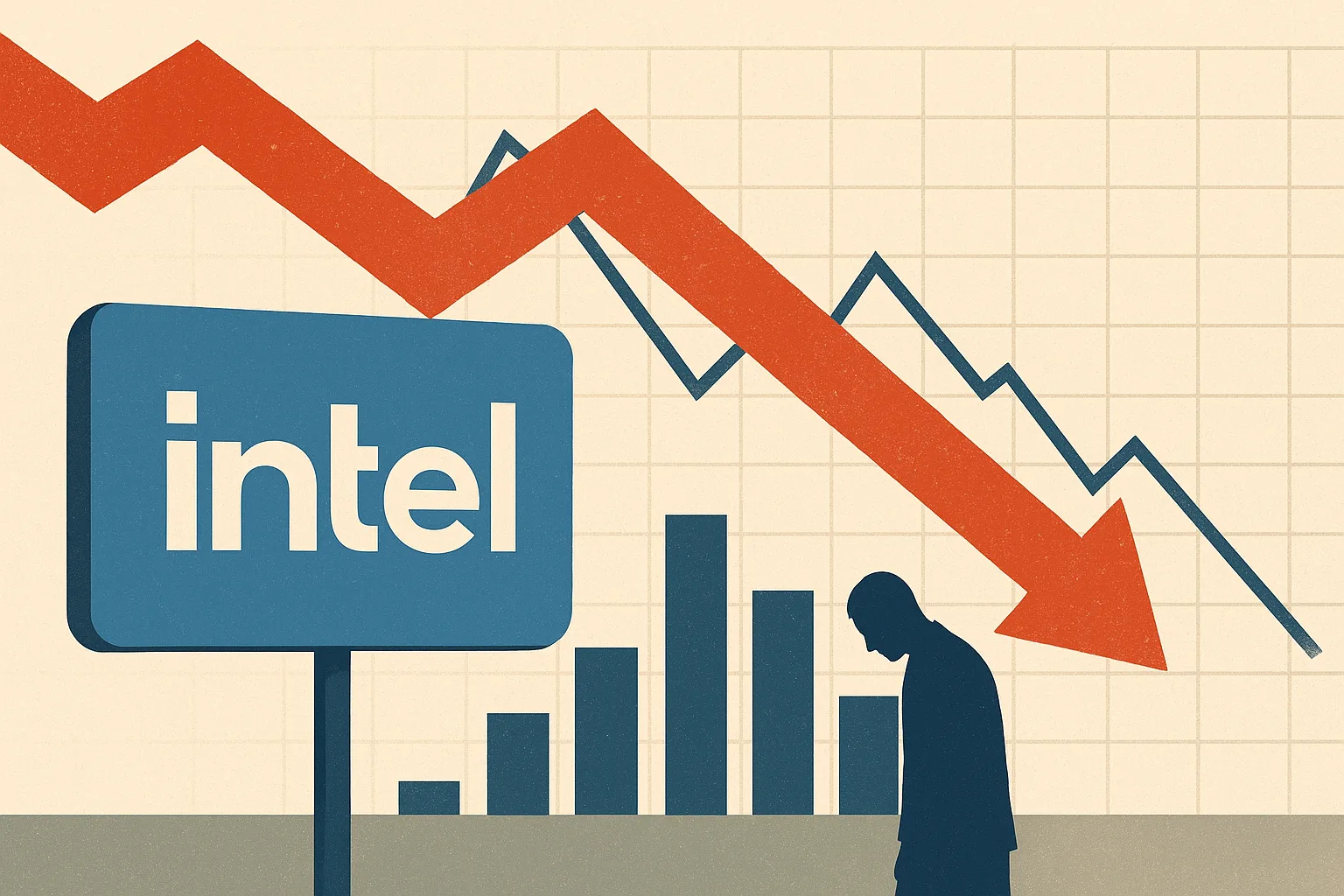
Intel, which had drawn attention as one of this year’s standout semiconductor names after more than doubling in value, saw its stock sharply reverse course in a single day. According to NewsPim, at 1:25 p.m. on the 30th local time, Intel was trading at $64.53, down 29.91% from the previous session. That was described as the biggest one-day drop since stock price tracking began in 1982.
The immediate trigger for the plunge was the company’s earnings outlook. The day before, Intel had issued quarterly revenue guidance that came in more than $1 billion below market expectations, and said it would be difficult for free cash flow to turn positive this year. Its fourth-quarter revenue forecast was $15 billion to $16 billion, falling short of the $17.07 billion consensus estimate compiled by LSEG. Free cash flow is the cash left after subtracting the spending needed to maintain and invest in the business, so an outlook that shows little improvement can be a drag on investor sentiment.
Behind the move are both weakness in the PC market and the rapid growth of the AI industry. The report said that rising prices for general memory, driven by high-bandwidth memory production for AI systems, have increased the cost of laptops and desktops, weakening PC demand. Since Intel’s PC chip business accounts for roughly half of its revenue, the boom in AI does not necessarily translate into gains for every semiconductor company in the same way.
The shock from Intel rippled through other stocks and the broader market as well. At the time of the report, AMD, Arm and Qualcomm were down by double digits, while Nvidia, Broadcom and Micron also fell. ASML and TSMC were weaker too, and the Nasdaq Composite and the KOSPI both declined. Server makers also came under pressure, suggesting a broader pullback in investor sentiment across AI-related companies.
The selloff also drew attention to Intel’s funding and credibility concerns, not just its valuation. According to the article, Intel’s market capitalization was expected to shrink by more than $146 billion, and the price of its five-year credit default swap, which reflects the market’s view of a company’s default risk, hit a record high. A CDS is a contract that protects against the risk that a bond issuer will fail to repay its debt, so a higher price indicates that the market sees greater credit risk.
This sharp drop does not by itself rule out Intel’s long-term recovery. Still, it makes clear that AI market growth alone will not support the stock; what matters just as much are a product mix aligned with actual demand, realistic revenue guidance, and careful cash flow management. Whether Intel can weather weakness in its PC business while also proving its competitiveness in AI-related markets is likely to remain a major focus for investors going forward.
The immediate trigger for the plunge was the company’s earnings outlook. The day before, Intel had issued quarterly revenue guidance that came in more than $1 billion below market expectations, and said it would be difficult for free cash flow to turn positive this year. Its fourth-quarter revenue forecast was $15 billion to $16 billion, falling short of the $17.07 billion consensus estimate compiled by LSEG. Free cash flow is the cash left after subtracting the spending needed to maintain and invest in the business, so an outlook that shows little improvement can be a drag on investor sentiment.
Behind the move are both weakness in the PC market and the rapid growth of the AI industry. The report said that rising prices for general memory, driven by high-bandwidth memory production for AI systems, have increased the cost of laptops and desktops, weakening PC demand. Since Intel’s PC chip business accounts for roughly half of its revenue, the boom in AI does not necessarily translate into gains for every semiconductor company in the same way.
The shock from Intel rippled through other stocks and the broader market as well. At the time of the report, AMD, Arm and Qualcomm were down by double digits, while Nvidia, Broadcom and Micron also fell. ASML and TSMC were weaker too, and the Nasdaq Composite and the KOSPI both declined. Server makers also came under pressure, suggesting a broader pullback in investor sentiment across AI-related companies.
The selloff also drew attention to Intel’s funding and credibility concerns, not just its valuation. According to the article, Intel’s market capitalization was expected to shrink by more than $146 billion, and the price of its five-year credit default swap, which reflects the market’s view of a company’s default risk, hit a record high. A CDS is a contract that protects against the risk that a bond issuer will fail to repay its debt, so a higher price indicates that the market sees greater credit risk.
This sharp drop does not by itself rule out Intel’s long-term recovery. Still, it makes clear that AI market growth alone will not support the stock; what matters just as much are a product mix aligned with actual demand, realistic revenue guidance, and careful cash flow management. Whether Intel can weather weakness in its PC business while also proving its competitiveness in AI-related markets is likely to remain a major focus for investors going forward.
Related search terms
#Intel stock plunge#Intel share price drops#semiconductor stocks fall#PC demand slowdown#AI investment burden#free cash flow concerns#Intel earnings outlook#credit default swap record