ECONOMY · 2026-10-27
Korea’s Q2 Current Account Surplus Hits $116.63 Billion, Beating Germany and Japan Combined
South Korea’s current account surplus in the second quarter of this year came to $116.63 billion. That was larger than the combined surpluses of Germany and Japan, and the IMF expects Korea to rank second in the world for annual surplus this year, just behind China.
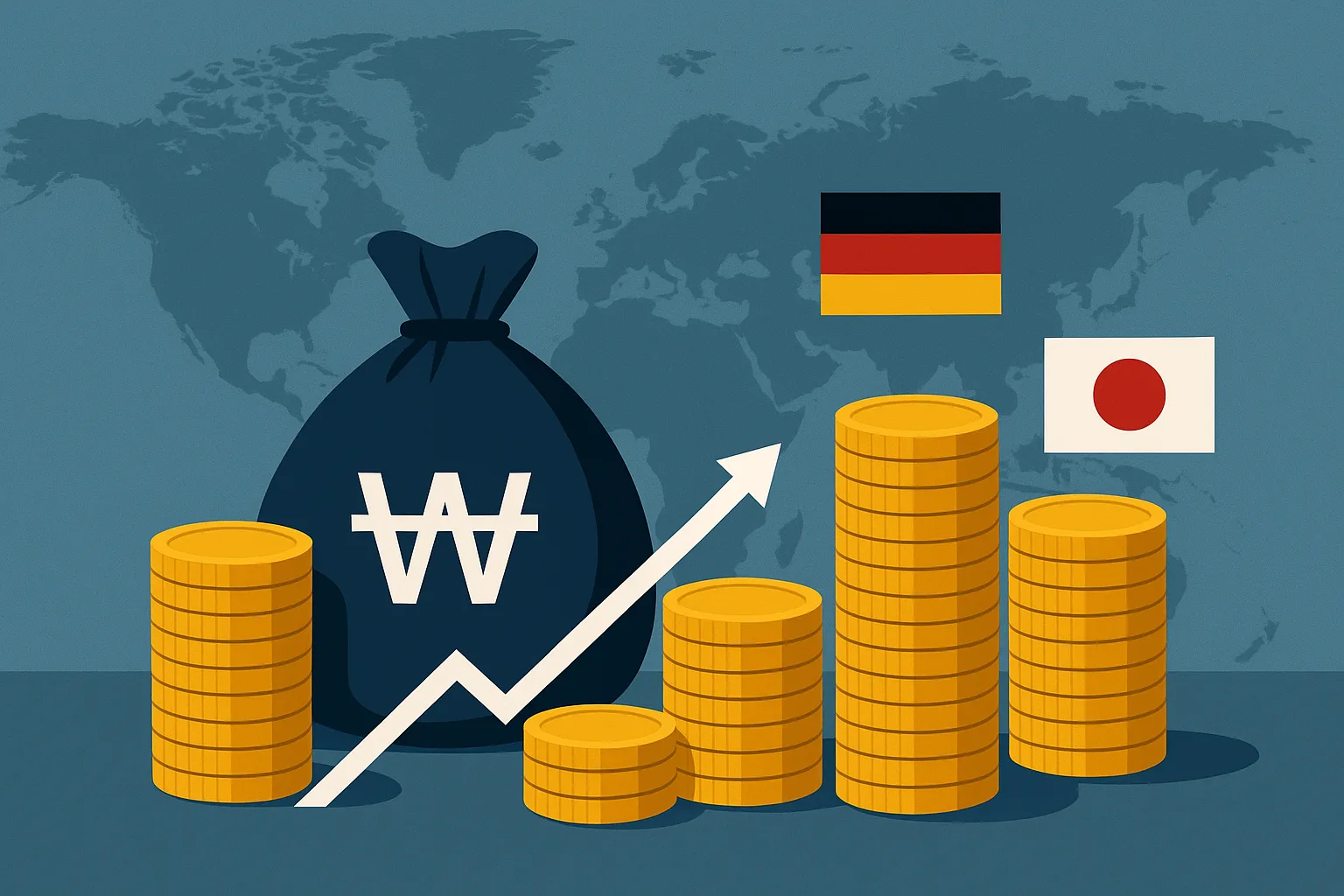
South Korea’s current account surplus in the second quarter of this year was larger than the combined surpluses of Germany and Japan. It is the first time that the total of these two major manufacturing powers has fallen short of Korea’s figure. That said, whether this level of performance can be sustained going forward is a separate question that still needs to be examined.
According to IMF major-country statistics listed in the Bank of Korea’s Economic Statistics System, Korea posted a current account surplus of $116.63 billion in the second quarter. Over the same period, China led with $193.72 billion, followed by Korea. Germany posted $52.28 billion, while Japan recorded $50.62 billion. Korea’s surplus was $13.74 billion larger than the combined $102.89 billion surplus of the two countries.
Since the first quarter of 1996, when data for Korea, Germany and Japan have all been available, this is the first time Korea’s surplus has exceeded the combined total of Germany and Japan. Korea’s second-quarter current account surplus was $28.39 billion a year earlier, meaning this year’s figure was 4.1 times larger. In the same period, Germany’s surplus rose only 11.9%, while Japan’s increased by just 5.0%.
The current account is an indicator that shows a country’s income and spending with the rest of the world by combining trade in goods and services as well as income generated from overseas investment. A larger surplus means a country earned more from abroad than it paid out overseas. The main factors highlighted in the article behind this result were higher semiconductor prices and strong exports. According to data compiled by the national statistics office, semiconductor exports in the second quarter reached $113.89 billion, up 181.6% from a year earlier, and in the third quarter they rose to $148.02 billion, an increase of 218.7%.
The IMF’s October World Economic Outlook projected South Korea’s annual current account surplus at $421.946 billion this year. Among 190 countries and regions with forecasts available, that would be the second-largest surplus after China, moving Korea up three places from last year to No. 2. The increase in this year’s surplus was also expected to be the largest, at $298.892 billion. As a share of GDP, the current account surplus was forecast at 18.8%, which would be the highest since IMF statistics began in 1980.
However, a large surplus should not be interpreted too quickly as a sign of long-term stability. While the IMF expects Korea’s current account surplus to remain above $400 billion in both next year and 2028, it also projects it to fall to $295.656 billion in 2029 and $177.491 billion in 2031. Since this latest data largely reflects Korea’s export competitiveness and the semiconductor boom, it is worth watching not only the pace of export growth but also the degree of dependence on a handful of industries and the sustainability of the surplus itself when assessing future trends.
Source: 한국 2분기 경상흑자 독일과 일본 합친 것보다 많았다
Related search terms
#Korea current account surplus#South Korea Q2 current account surplus#IMF Korea surplus forecast#Korea exports and semiconductor boom#Germany Japan current account surplus#Bank of Korea IMF statistics#South Korea trade surplus outlook