AI · 2026-10-22
PHP accounts for 82.7% of domestic websites... Hurry to update the PHP2Shell vulnerability
Of the websites in Korea where a server-side language was identified, 82.7% were found to use PHP. As the ‘PHP2Shell’ vulnerability in PHP itself has been disclosed, PHP developers have released patched versions, and the government and KISA are also urging security updates and intrusion checks.
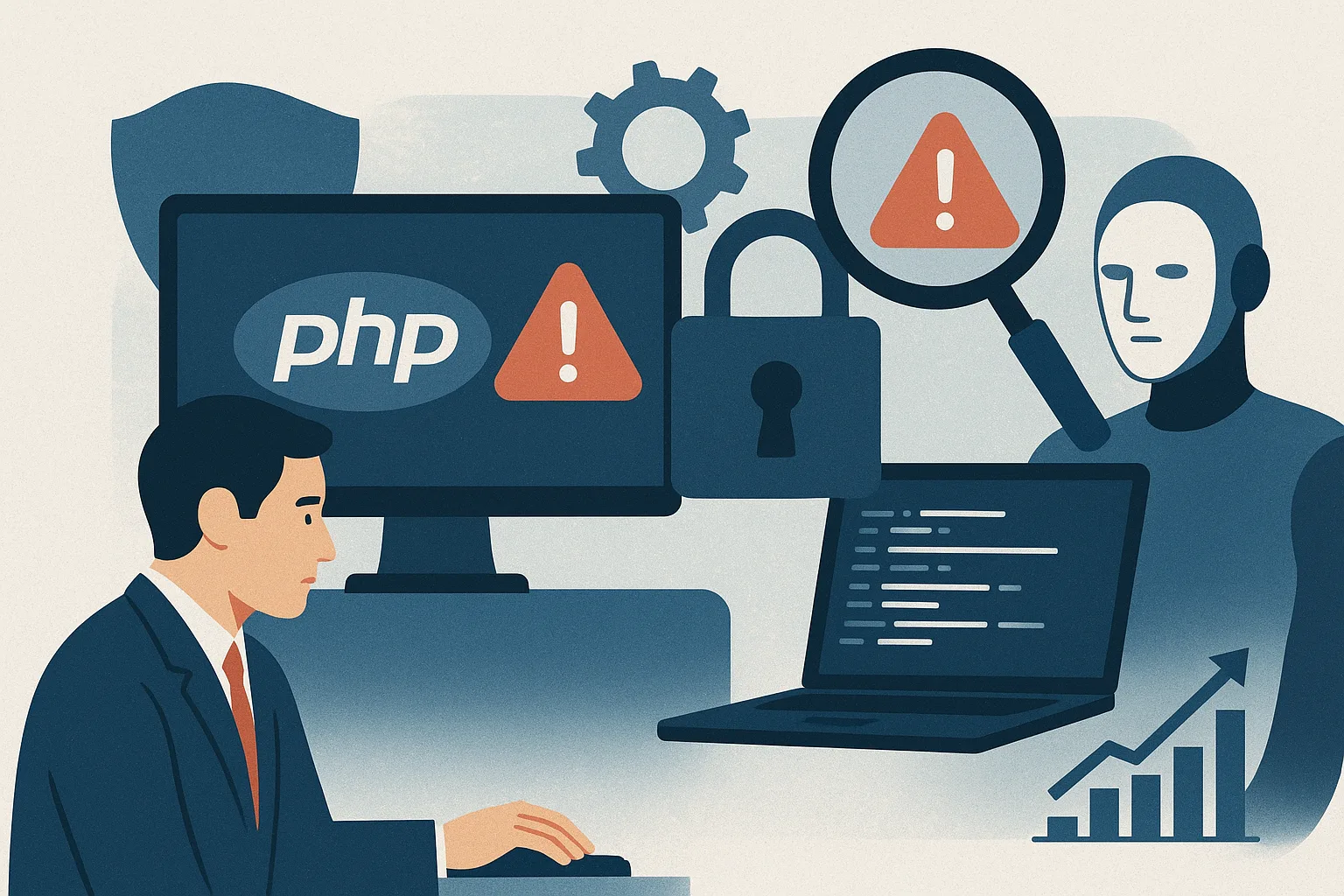
A vulnerability has been disclosed in PHP, a language widely used for building websites, that can allow malicious commands to run on a server without a login. Since PHP has such a large share among domestic websites, homepage operators as well as companies and public institutions need to check not only their site software, but also the version of PHP installed on their servers.
According to a report by Digital Times, statistics from web technology research firm W3Techs show that among websites classified as having servers located in Korea and for which a server-side language was identified, PHP usage stood at 82.7%. That is higher than the global figure of 69.3%, and for the .kr domain alone, it is 75.1%. However, this statistic covers only websites whose server-side language could be identified, so it should be distinguished from a full census of all domestic websites.
This flaw is known to exist in PHP itself, not in the program of an individual homepage. That means even a well-secured site may be affected if it is running a vulnerable version of PHP on its server. If an attack succeeds, it could lead to information theft or data tampering. Security firm Wiz reportedly demonstrated attacks that execute code without authentication in WordPress, Drupal, and Joomla environments, and read passwords, authentication tokens, and API keys stored in server memory.
The two vulnerabilities known as ‘PHP2Shell’ were discovered by security researchers using artificial intelligence. PHP developers released fixed versions on the 21st local time: 8.5.12, 8.4.27, 8.3.36, and 8.2.35. In particular, the mod_php environment on the Apache web server is considered highly risky because attacks may be possible even before the site application itself runs.
The government has also begun responding. The Ministry of Science and ICT and the Korea Internet & Security Agency (KISA) raised the private-sector cyber crisis alert level from ‘attention’ to ‘caution’ and urged companies and institutions using PHP to apply emergency updates and check whether they have been compromised. They also advised switching from unsupported PHP 8.1 and earlier versions to newer, supported releases.
Operators should not stop at checking updates for their website builder tools or plugins; they need to verify whether the fixes have actually been applied to PHP itself on the server. If they use a hosting service, it is a good idea to ask the provider whether patches have been installed. Some configuration changes can reduce attack paths, but they are no substitute for security updates. In an environment like Korea, where PHP is used so widely, it has become especially important not to leave vulnerable versions in place and to carry out basic checks without delay.
According to a report by Digital Times, statistics from web technology research firm W3Techs show that among websites classified as having servers located in Korea and for which a server-side language was identified, PHP usage stood at 82.7%. That is higher than the global figure of 69.3%, and for the .kr domain alone, it is 75.1%. However, this statistic covers only websites whose server-side language could be identified, so it should be distinguished from a full census of all domestic websites.
This flaw is known to exist in PHP itself, not in the program of an individual homepage. That means even a well-secured site may be affected if it is running a vulnerable version of PHP on its server. If an attack succeeds, it could lead to information theft or data tampering. Security firm Wiz reportedly demonstrated attacks that execute code without authentication in WordPress, Drupal, and Joomla environments, and read passwords, authentication tokens, and API keys stored in server memory.
The two vulnerabilities known as ‘PHP2Shell’ were discovered by security researchers using artificial intelligence. PHP developers released fixed versions on the 21st local time: 8.5.12, 8.4.27, 8.3.36, and 8.2.35. In particular, the mod_php environment on the Apache web server is considered highly risky because attacks may be possible even before the site application itself runs.
The government has also begun responding. The Ministry of Science and ICT and the Korea Internet & Security Agency (KISA) raised the private-sector cyber crisis alert level from ‘attention’ to ‘caution’ and urged companies and institutions using PHP to apply emergency updates and check whether they have been compromised. They also advised switching from unsupported PHP 8.1 and earlier versions to newer, supported releases.
Operators should not stop at checking updates for their website builder tools or plugins; they need to verify whether the fixes have actually been applied to PHP itself on the server. If they use a hosting service, it is a good idea to ask the provider whether patches have been installed. Some configuration changes can reduce attack paths, but they are no substitute for security updates. In an environment like Korea, where PHP is used so widely, it has become especially important not to leave vulnerable versions in place and to carry out basic checks without delay.
Related search terms
#PHP usage rate in Korea#PHP2Shell vulnerability#PHP security update#KISA PHP warning#Apache mod_php vulnerability#WordPress PHP security#Korea website PHP statistics